How Travlinq Enables Agentic AI in Travel Operations
Most travel systems today were built for people. Travlinq is being built for a future where both humans and AI agents operate together.

Most travel systems today were built for people.
Travlinq is being built for a future where both humans and AI agents operate together.
That difference matters more than most companies realize.
Agentic AI doesn’t work well inside fragmented workflows, disconnected APIs, or rigid booking architectures.
AI agents need systems that are:
- real-time,
- observable,
- event-driven, and
- capable of executing decisions dynamically.
This is exactly where Travlinq creates the foundation.
1. Unified Operational Layer for AI Agents
Traditional travel stacks spread logic across multiple systems:
booking engines, middleware, supplier APIs, CRM tools, payment gateways, cancellation engines, and reporting systems.
For a human operator, this creates inefficiency.
For an AI agent, it creates paralysis.
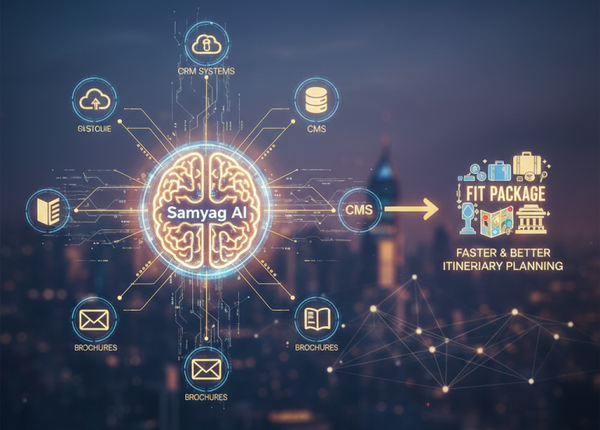
Travlinq solves this by creating a unified operational layer where supplier connectivity, booking workflows, pricing logic, and operational events can be accessed through a consistent structure.
This gives AI agents:
- a cleaner execution environment,
- predictable workflows, and
- centralized operational visibility.
Instead of teaching an AI how 20 suppliers behave differently,
Travlinq abstracts that complexity into a normalized operational model.
2. Structured Context for Intelligent Decisions
AI agents cannot make intelligent decisions from raw API responses alone.
They need context like:
- supplier reliability history,
- cancellation behavior,
- pricing volatility,
- booking states,
- operational SLAs,
- customer priority levels,
- disruption patterns.
Travlinq’s architecture enables this contextual layer by consolidating operational signals into a unified ecosystem.
This allows Agentic AI to move beyond simple automation into actual reasoning.
Example:
An AI agent detecting a supplier delay could:
- identify alternative suppliers,
- compare fulfillment probability,
- evaluate margin impact,
- trigger rerouting logic, and
- notify the customer proactively.
Not because it was manually scripted for one scenario, but because the system provides structured operational intelligence.
3. Event-Driven Architecture for Real-Time AI Actions
Agentic systems depend on events.
Inventory changes.
Price shifts.
Cancellation windows.
Supplier outages.
Failed bookings.
Payment anomalies.
Traditional systems process many of these reactively or in batches.
Travlinq is designed to support continuous operational awareness.
This enables AI agents to:
- monitor live operational conditions,
- detect anomalies early, and
- trigger actions autonomously.
In practice, this means AI can evolve from “assistant” → “operator.”
4. Faster AI Deployment Without Rebuilding Core Systems
One of the biggest barriers to AI adoption in travel is infrastructure readiness.
Most companies realize too late that their systems cannot support real-time AI orchestration without major rewrites.
Travlinq reduces this friction by acting as an operational abstraction layer.
Instead of rebuilding supplier logic repeatedly, businesses can deploy AI capabilities on top of a standardized operational foundation.
This dramatically accelerates:
- AI experimentation,
- workflow automation,
- operational copilots, and
- autonomous support systems.
5. AI-Ready Connectivity Instead of API Chaos
Most API ecosystems were designed for connectivity not intelligence.
Travlinq shifts the model toward AI-ready connectivity:
where systems are not only connected, but structured in ways that autonomous agents can understand, monitor, and act upon.
This distinction will define the next generation of travel infrastructure.
Because in the future, the most valuable platforms won’t simply expose APIs.
They’ll expose decision-ready operational ecosystems.
The Bigger Vision
At Travlinq, we don’t see Agentic AI as a feature add-on.
We see it as the next operational layer of travel technology.
The industry is moving from:
- manual operations → automation,
and now from: - automation → autonomous orchestration.
That transition requires more than AI models.
It requires systems architected for adaptability, real-time coordination, and intelligent execution.
That’s the foundation Travlinq is building toward.
Final Thought
The future of travel operations won’t depend on who has the biggest AI model.
It will depend on whose systems allow AI to:
- understand operations clearly,
- make decisions confidently, and
- execute actions reliably.
That’s where the real infrastructure shift is happening.
And that’s where Travlinq positions itself not just as a connectivity platform,
but as an AI-enablement layer for the future of travel operations.